
logo

Let’s just see what happens

Newsletter

Videos

Speaker

Hard to Read? Choose a style: Style 1 Style 2 Style 3 Default Toggle Sidebars

Me and Mr. Keen

Posted on July 18th, 2007

The Wall Street Journal online has published an exchange between Andrew Keen (”The Cult of the Amateur”) and me. The full version is here. The condensed version is here. (I recommend the full version.) [Tags: andrew_keen web2.0 cult_of_the_amateur everything_is_miscellaneous ]

Categories: digital culture, everythingIsMiscellaneous, media

Previous: « Susan Mernit learns from fads || Next: Saw Sicko. See Sicko »

13 Responses to “Me and Mr. Keen”

  1. Jon Husband, on July 18th, 2007 at 10:34 am Said:

    I respect your attempt to escape from the either/or realities of market economics. But I’m afraid this is the binary logic of life. The culture business is ugly. It rewards talent and punishes those who don’t have it.

    I like that following this assertion by Andrew that the conversation began to focus on the institutions that have decided what is talent and what is not. Will there be new forms of business / commercial logic that let more monkeys make some money ? I suspect so, but the attempts thus far are inchoate.

    Is making money finally the only determinant of the value and worth of what someone has created ? I keep asking myself this as I read Andrew’s statements. If so, then a decent portion of what comes out of universities as “knowledge” might be suspect and tenure should be abolished to be replaced by annual measurement of revenue generation ?

    Are people who use the Web (wikis, blogs, forums, mailing lists) for activism and to develop communities (whether small, medium or large) around issues of interest only mimicking chimps who fling poo at each other for fun and to escape boredom ?

    Are people who do not use professional jargon or established formats to express themselves yet probe and explore issues in any given area in a deep and comprehensive manner less worthy or less talented ? Perhaps and perhaps not, but the gatekeepers Andrew trusts have not always shown themselves to be the epitome of trustworthiness, in my opinion. Would he suggest that people on the Web not criticize the editors and senior journalists of the Washington Post, the NY Times, the LA Times, the Guardian, Le Monde, etc. because, really, they know what they are doing, because they are the professionals ?

    There are many people in many professional areas that in real life should have remained amateurs, and many (often unknown or undiscovered) amateurs who could or should replace exisiting professionals.

    Andrew has I think a (very) health regard for the established ways of things, and perhaps a well-developed fear of ambiguity, and is apparently not so willing to consider that we are still learning much about how people may, can and will operate with and within these new conditions.

    I agree with you that he might want to first widen and then winnow his range of blog reading … but his mental model going in may be a bit of an obstacle with respect to discovering new sources of expertise, talent and cultural expression.

  2.  

  3. John Caddell, on July 18th, 2007 at 12:42 pm Said:

    David, I enjoy your blogs and am in the middle of “Everything is Miscellaneous” and like that a lot too. On this argument, I’m on your side.

    I was struck by your comment, “And that’s because, while some talent is indeed solitary, many types of talent prosper in connection with others.” I just finished reading a book called “Smart World” by Richard Ogle that basically said very few profound creations were achieved by solitary beings–that revolutionaries like Picasso to Gutenberg made deep external connections that were integral to their breakthroughs.

    So connections have been with us forever. What’s really cool about the web (and Web 2.0 in particular) is that it’s made connecting so much easier.

    Regards, John

  4.  

  5. David Martin, on July 18th, 2007 at 12:54 pm Said:

    Bravo Dave on presenting an excellent argument. Andrew seems to enjoy the attention earned by playing agent provocateur, however, he argues for an oddly narrow ideal. His suggestions require a supreme arbiter or at least a content czar. No thank you. Simply put his case lacks merit. Perhaps Andrew suffers from a delusion akin to that which Pope Leo X experienced. You may recall his notion was Luther would just go away and he dismissed him as a drunk who once sober would change his mind.

  6.  

  7. Jay Fienberg, on July 18th, 2007 at 3:11 pm Said:

    I wonder what useful debate people might have on these topics if “web 2.0″ weren’t the frame of reference? As an analogy, imagine a debate about dietary practices that doesn’t frame things in terms of the evils of “chocolicious food.”

    Web 2.0 has been some individuals’ and groups’ way of reasserting a “dot com”-style soundbyte idea about the World Wide Web. It seems like Keen is focued on that soundbyte–which is neither the ideas of the web nor the people amongsts those ideas.

  8.  

  9. Jon Husband, on July 18th, 2007 at 6:03 pm Said:

    Phil Cubeta follows the exchange at a remove, on the Gift Hub blog, and weighs in with his typical acumen …

    My own sense is that as a professional I am good at what I do and sometimes a poor excuse for a human being. As a professional many of us live in one of the “iron cages” that Max Weber describes, held in place by a business model, a business plan, an org chart, a supervisory mechanism, a regulatory mechanism, a public relations dept, a corporate style guide, a dress code, an annual performance review, a mid-year check point, a salary and bonus incentive system, a code of civility, and on and on. As an amateur, well, then all bets are off. I am far more interested in what a Pundit thinks as an amateur, off the record, talking with a few close friends over a beer than I am in the talking points the Pundit iterates on Company Time or in the Corporate Media at the behest of their Supervisor and their Funders. Another name for professional is hireling. That was Jonathan Swift’s word. Another name for amateur is “citizen.” The web is a citizen-driven public space. To make it a medium for rich, branded, professional, corporate controlled, content would be a true tragedy of the commons.

  10.  

  11. Joe Buhler, on July 18th, 2007 at 6:36 pm Said:

    Bravo! David for countering the rather lame arguments of Mr. Keen who seems to be mostly interested in raising controversy, probably to get onto that top list of non-fiction bestsellers of the NYT.

    I pity the person who has to depend to on the mass media for his or her interpretation of the world. It’s the same mass media that gives us the National Enquirer and daytime TV drivel, both not mentioned by Mr. Keen in his defense of the old status quo.

  12.  

  13. Betsy Devine, on July 18th, 2007 at 7:40 pm Said:

    You land some surprisingly hard punches on Mr. Keen there, considering (as noted in my blog’s comments ) that you are “a sweet-natured vegetarian fan of John Lennon.”

    Meanwhile–I love this–BoingBoing is blushing that Keen praised them during your dustup! http://www.boingboing.net/2007.....plime.html

  14.  

  15. ismael, on July 19th, 2007 at 10:41 am Said:

    IMHO, the debate you and Keen had was not about the Internet but about Education and Literacy (be it digital or “analogue”).

    I guess we’d do ourselves a favor if we shifted the debate towards these issues… in other words, towards the moon and not towards the finger that points at it.

    :)

  16.  

  17. Seth Finkelstein, on July 19th, 2007 at 11:17 am Said:

    She said it, not me:

    http://burningbird.net/connect.....thorities/

    “Let’s disregard for a moment that both have books to sell…no, let’s not disregard that they both have books to sell. What struck me most about both the video and email debate is that their central point of disagreement is about the importance of authority, but both are living examples of each other’s arguments.

    Andrew Keen is fundamentally a non-authority arguing for the importance of authority on the web; while David Weinberger is an acknowledged authority on the emergence of a non-authoritative new world order. They could save time if, in a debate, they would just point to each other as a living example of what each is promoting. The audience can then get to the beer that much more quickly.”

  18.  

  19. hernani dimantas, on July 20th, 2007 at 9:52 am Said:

    well, each one has the internet that deserves; mr. keen analyses is conservative naive; his critics is about the way the web carries on; but he does not realise that is the inexorable trend. the thing are happening that way. it is about our way to link ourselves, to collaborate and to do things.

  20.  

  21. hugh macleod, on July 21st, 2007 at 9:29 pm Said:

    I debated Andrew in front of a crowd a couple of weeks ago… I STILL don’t know what his thesis is, except that he doesn’t relish the idea of a certain class of media professional losing their cushy jobs, and having to go work for a living like everyone else…

    I’m not sure he does, either. Even the people in the audience with “pre-Cluetrain” gigs were scratching their heads…

  22.  

  23. Eric Gauvin, on July 25th, 2007 at 11:33 am Said:

    I read and liked Keen’s book. I’m now just learning about Weinberger, so I’m not aware of his status as a leading authority on the internet (apparently with loyal fans willing to agree with him virtually all of the time). I’ll have to get my hands on his miscellaneous book. As for the debate, I personally thought Keen made some really interesting points. Weinberger seemed passionate and utterly flabbergasted that Keen couldn’t see the light, but although I share his enthusiasm about the open characteristics of the web, I wasn’t so intrigued by anything he had to say.

  24.  

  25. Eric Gauvin, on July 28th, 2007 at 10:25 pm Said:

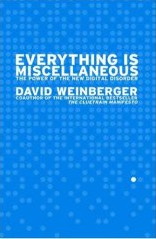
    Okay. I’m back. I’ve read Everything is Miscellaneous. I’m not so great at writing book reviews, so I’ll just say that I agree completely with this review (below) by “Yaron” from amazon.com. I think his review is a really accurate assessment of the book. In my research about the book I also found a review that described it as a “buzz” book that people read by default (not because of its merits). I think that’s also true, and I think it’s unfortunate that this book exacerbates the “in-group/out-group” thinking of the Web 2.0 “movement.” The irony being that Web 2.0 strongly promotes freedom, yet Web 2.0 zealots such as Weinberger are really starting to look like members of a private club who support each other’s blogs, books, speaking engagements, etc.

    The following review is by “Yaron” from amazon.com:

    “The big contribution of “Everything is Miscellaneous”, I think, is the concept of “orders”. “First-order order” is structuring, like the placement of sentences in a text or products on a shelf. “Second-order order” is classification, putting information into categories and subcategories, maps,, etc. “Third-order order” is tagging and other meta-data, which allow us to make our own categorization on the fly (”give me a list of all books in this bookstore, divided by century published and subdivided by genre”). It’s a neat set of phrasing, and if the book is not remembered for anything else, hopefully that taxonomy will remain.

    Where the book falls short, though, is in its own “first-order order”, its organization of ideas; which may be sadly appropriate for a book extolling “messiness”. The book jumps from topic to topic, introducing ideas and people seemingly (to my mind) haphazardly, and in a way that makes it hard to keep track of all that has been covered. A better system of organization might have been chronological. After all, the full possibilities of tagging, or “third-order order”, have only been enabled by computers and the Web. How much more interesting could it have been if we could see the progression of techniques for ordering and taxonomy through time, as a function of improving information technologies? Have there been pre-computer attempts at tagging? You can get a sense for some of these issues by piecing out the historical anecdotes Weinberger places, but it would have been easier to see them in a more natural order.

    On that note, I also think Weinberger gives too little time to historical attempts at classification. The book does contain interesting examples of thoughts about categorization, from the ancient Greeks onward, but too often Weinberger stacks the deck against previous generations, by bringing in such loaded examples as apartheid South Africa’s classification of races or psychiatrists’ old definition of homosexuality as an illness. That unfairness extends even to book classification, where Weinberger talks at length about the badly-designed Dewey Decimal System, but ignores the Library of Congress system, which is nearly as old and much better-produced.

    Blogs, on the other hand, get a lot more attention in the book than I think they should: they do not provide meta-data at all but rather commentary, and those two are not the same thing. Weinberger does not clarify that distinction, and in fact at one point asserts that “everything is metadata”. That’s not true in any rigorous sense, and I think just further confuses the issue.

    On other current technologies I give “Everything is Miscellaneous” a mixed review. Wikipedia gets a prominent mention, as it should, but there’s no discussion of categories within Wikipedia, which is the biggest effort at what could be called “collaborative tagging”, as distinct from the standard web model of every user creating their own tags. And there’s a nice discussion of the Semantic Web, but none of semantic wikis; Weinberger missed a chance to think a little ahead of 2007 (I’m speculating here a little bit).

    For an information-science enthusiast like me, just about any discussion of classification is interesting; however, this book unfortunately does not provide a solid or clear overview of the theory of classification, instead getting caught up in what I see as Web boosterism. Yes, the Web has changed a lot about categorization, but not *everything* on the Web has done that.”

  26.  

Leave a Reply


Web Joho only


Entries (RSS)
Copy this link as RSS address

Comments (RSS).
Creative Commons License
Joho the Blog by David Weinberger is licensed under a Creative Commons Attribution-Noncommercial-Share Alike 3.0 United States License.

Creative Commons license: Attribute it to me, share it with others, don't use it commercially without my permission.

Joho the blog uses WordPress blogging software.
Thanks, WordPress!