
logo

Let’s just see what happens

Newsletter

Videos

Speaker

Hard to Read? Choose a style: Style 1 Style 2 Style 3 Default Toggle Sidebars

Alex Wright’s GLUT

Posted on January 4th, 2008

I’ve just ordered a copy of Alex Wright’s book, GLUT, which sounds fascinating:

What do primordial bacteria, medieval alchemists, and the World Wide Web have to do with each other? This fascinating exploration of how information systems emerge takes readers on a provocative journey through the history of the information age.

Spanning disciplines from evolutionary theory and cultural anthropology to the history of books, libraries, and computer science, writer and information architect Alex Wright weaves an intriguing narrative that connects such seemingly far-flung topics as insect colonies, Stone Age jewelry, medieval monasteries, Renaissance encyclopedias, early computer networks, and the World Wide Web. Finally, he pulls these threads together to reach a surprising conclusion, suggesting that the future of the information age may lie deep in our cultural past.

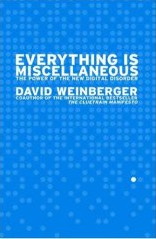
I found it via Terry Jones’ post about it, with references to that Miscellaneous book. Terry is chasing a database architecture that doesn’t suffer from the old limitations of space-based thought or limited computing resources. Terry promises more in a later post, so we’ll find out…

[Tags: alex_wright glut terry_jones fluidinfo metadata everything_is_miscellaneous ]

Categories: everythingIsMiscellaneous, metadata

Previous: « Dance, puny customer, dance! || Next: A blogger dies in action »

3 Responses to “Alex Wright’s GLUT”

  1. Frank Hecker, on January 4th, 2008 at 3:38 pm Said:

    Coincidentally, I just finished “Glut”. I found it interesting as a historical overview of various ways people have approached the problem of organizing and accessing information; it’s a useful guide for people who think that this history began with Tim Berners-Lee.

    In my opinion it’s not a particularly earthshaking book, and I think most of the content will be familiar to the typical reader of “Everything is Miscellaneous”. There were however a couple of examples new to me, including Paul Otlet and the origins of the Universal Decimal Classification (not mentioned in EIM as far as I can tell). (However I’ll take points away from Wright for referencing an Appendix E on the UDC that doesn’t actually appear in the book.)

    I’m not sure exactly what the “surprising conclusion” is that was referenced in the book’s blurb; among Wright’s points (at least the ones I remember) are

    1. Ways of organizing information aren’t just intellectual constructs; they are built on and intertwined with deep biological and social factors.

    2. Humans naturally think in terms of hierarchies, and hierarchies which are organized in particular ways (e.g., as in the taxonomies of “folk biology”).

    3. There is a continuing tension between hierarchical and networked ways of looking at the world, and between written and oral modes of communication (with present-day Internet usage having many aspects of orality).

    4. Shifts between different ways of communicating / organizing information can be very wrenching for the societies involved, e.g., printing in Europe as a catalyst for religious wars and other societal conflict. (John Robb’s net-enabled “open source warfare” could be cited as a contemporary example of this.)

    I think “Glut” can be usefully read in combination with EIM; a book combining the strengths of both would have been killer.

  2.  

  3. Are D. Gulbrandsen, on February 11th, 2008 at 12:14 pm Said:

    I’m looking forward to hearing both Alex Wright and you at the Topic Maps 2008 conference in April.

  4.  

  5. www jeux de casino, on June 4th, 2008 at 11:07 am Said:

    www super casino…

    Breathe no deposit casino on line 7 card stud casino bonus cingular free from ringtones free poker…

  6.  

Leave a Reply


Web Joho only


Entries (RSS)
Copy this link as RSS address

Comments (RSS).
Creative Commons License
Joho the Blog by David Weinberger is licensed under a Creative Commons Attribution-Noncommercial-Share Alike 3.0 United States License.

Creative Commons license: Attribute it to me, share it with others, don't use it commercially without my permission.

Joho the blog uses WordPress blogging software.
Thanks, WordPress!